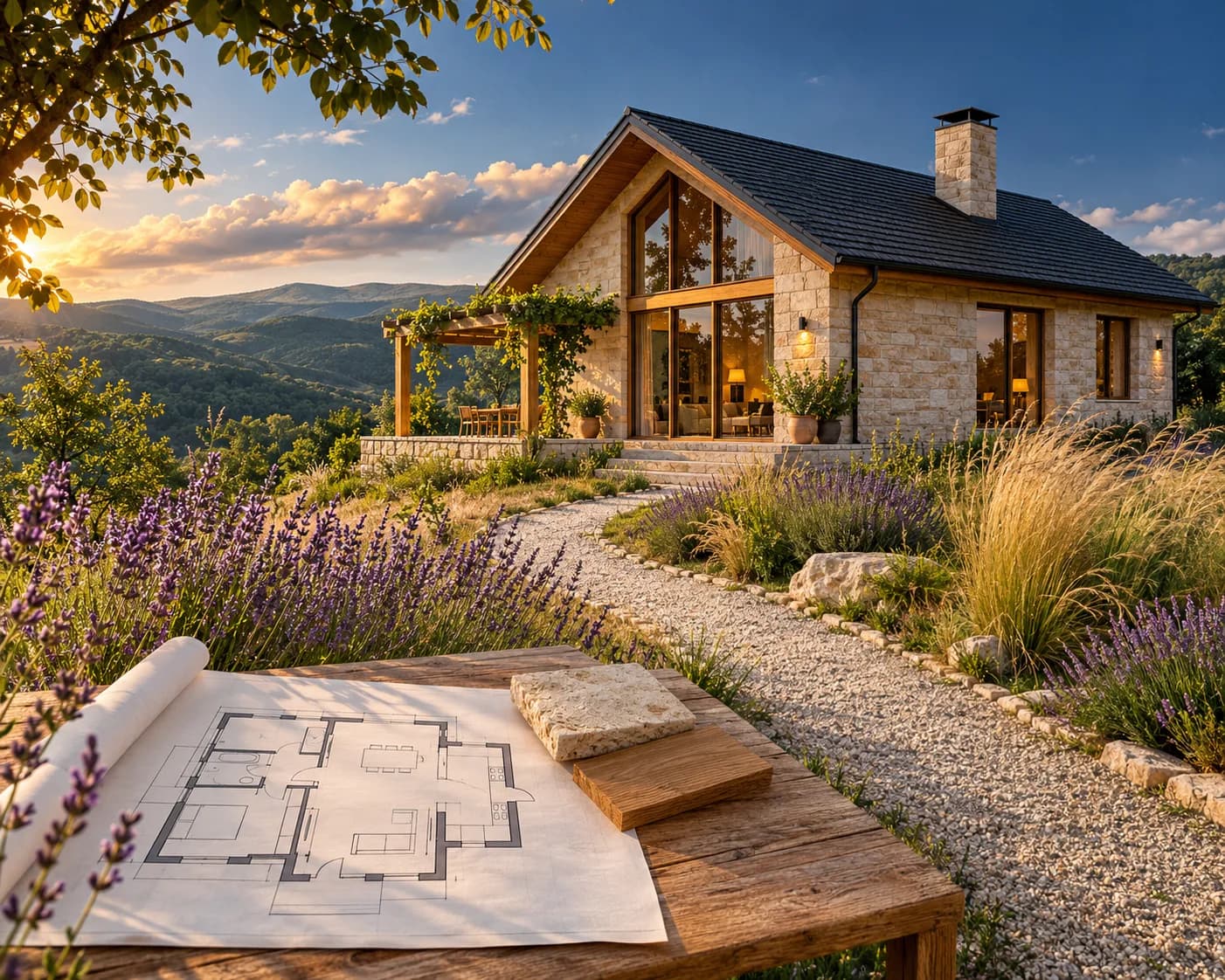
How to build a house in Bulgaria from scratch: from choosing a plot of land to putting it into operation
Introduction
Building your own house in Bulgaria is an attractive opportunity for those who want to live by the sea, in a quiet suburb, a small town or picturesque countryside. However, the path from buying an empty plot to a finished house requires an understanding of Bulgarian legislation.
What land can be used to build a house
Plots of land differ in their designated purpose, territorial location, whether they are covered by urban planning regulation, and the permitted types of use.
Regulated plot of land — UPI
Урегулиран поземлен имот (UPI) is the most convenient option. The boundaries and designated purpose of the plot are set by the applicable detailed development plan (PUP). If the plot is intended for residential development, construction of an individual house may be permitted on it.
But UPI status does not guarantee the possibility of building any house: the plot may have another designated purpose, for example public services or industrial activity. The permissible development, building lines, height and restrictions are checked.
Unregulated plot of land
Such a plot may be located within a settlement or outside it. The intended construction may require drawing up or amending a PUP. The procedure depends on the location, the urban planning documents and the capacity of the territory. Sometimes regulation is impossible.
Agricultural land
Земеделска земя is usually intended for agricultural use rather than for an ordinary residential house. As a rule, a change of the land’s designated purpose will be required, including urban planning and other approvals. A positive outcome is not guaranteed.
In certain cases, structures related to agricultural activity are permitted, but they cannot automatically be equated with a residential house for permanent living.
Forest, resort, coastal and protected areas
Forest territories have a special regime under the Forests Act. Near the Black Sea, nature parks, protected zones and Natura 2000, additional restrictions may apply. Even a regulated plot does not always allow the desired project to be carried out. For coastal areas, the Black Sea Coast Spatial Development Act is taken into account.
Who has the right to buy a plot of land
The right of acquisition depends on citizenship, the buyer’s legal status and the category of land. Citizens of Bulgaria and other EU states can, as a rule, acquire plots subject to the statutory conditions. Special restrictions apply to citizens of non-EU countries. Holding a long-term residence permit or a permanent residence permit does not in itself lift them.
One common option is the purchase of land by a Bulgarian company (EOOD (single-member LLC) or OOD (LLC)). In that case the owner is a legal entity, and personal use of the house may have tax and accounting consequences.
Another option is право на строеж: under the conditions laid down by law, the owner of the building and the owner of the land may be different persons. Whether such an arrangement is applicable to a specific foreign buyer is checked separately.
What to check before buying
Before signing a preliminary contract, the notarial deeds and ownership history, cadastral data, registered mortgages, attachments, easements and court disputes are checked.
The applicable PUP, the plot’s designated purpose, the permissible density and intensity of development, building lines, height, landscaping and the existence of lawful access to a road are analysed separately.
No less important are the options for connecting to electricity, water and sewerage, the terrain, geology, groundwater, the risk of flooding and the need for retaining walls. Actual vehicle access to the plot is not the same as legally secured access.
Change of the land’s designated purpose
For agricultural land, the Agricultural Land Protection Act applies. The procedure may include an admissibility assessment, preparation and approval of urban planning documentation, environmental approvals and a decision by the competent authority on the change of designated purpose. A separate procedure applies to forest territories.
Approval of a PUP does not always mean that the procedure for changing the designated purpose is complete. Before buying, it is necessary to check the likelihood of a positive decision and all the conditions for it to enter into force.
Completing the purchase
After the checks, the parties may conclude a preliminary contract setting out the price, payment terms, the parties’ obligations and the consequences of discovering obstacles to construction. The final transaction is executed by a notarial deed before the competent notary, after which the deed is entered in the Property Register.
The buyer should take into account the local acquisition tax, notarial and registration fees and the cost of legal support. When buying through a company, it is important to determine the accounting and tax model in advance.
Starting the design work
The architect studies the urban planning conditions and determines whether the desired house can be built. If necessary, a design visa (виза за проектиране) is requested. It is not required in all cases. If the applicable PUP does not permit the required development, it may need to be amended.
A geodetic survey establishes the terrain and elevation marks, while engineering-geological studies establish the properties of the soil and the conditions for laying the foundation.
The investment project
The project is prepared by qualified specialists. Depending on the building, it includes architectural, structural and the necessary engineering parts: power supply, water supply, sewerage, heating, ventilation, energy efficiency and other solutions.
A ready-made project from the internet or an architectural sketch does not replace documentation that complies with Bulgarian requirements and the conditions of the specific plot.
Electricity, water and sewerage
With the electricity grid operator you clarify the capacity, the connection point and the technical conditions. With the ViK operator — the possibility of connecting to the water supply and sewerage. Where there are no centralised networks, lawful alternatives are considered, including a borehole or a local wastewater treatment system, taking into account technical and environmental requirements.
At the design stage you choose heating, cooling, thermal insulation, possible solar panels and other energy-efficient solutions.
Building permit
Once the design has been prepared and the necessary approvals obtained, the documents are submitted to the competent authority, usually the chief architect of the municipality. The design undergoes the prescribed checks and a conformity assessment. The разрешение за строеж must enter into force in the established manner.
Work may not be started on the basis of a submitted application alone. The permit has statutory time limits and conditions for remaining in force.
Possible construction technologies
A traditional brick or monolithic house is a common option, with reinforced concrete structures and masonry. Frame houses may use timber or steel structures. Timber houses are also permissible, provided the technical and fire safety requirements are met.
Prefabricated and modular houses are assembled from factory-made elements, but this does not automatically exempt them from a building permit. Container and mobile units require a separate assessment: whether they constitute a building or a movable object under the ZUT. The presence of wheels or the absence of a conventional foundation does not guarantee the right of permanent residence without permits.
You can choose an individual design or adapt a standard design to the specific plot.
Organising the construction works
Once the formalities for opening the construction site have been completed, work begins on site preparation, earthworks, foundations, load-bearing structures, walls, floor slabs and the roof. Then come the utility networks, thermal insulation, the façade and interior finishing, landscaping, drainage and access roads.
Mandatory acts and protocols are drawn up during the process. The set of participants — the investor, the designers, the contractor, the technical manager and the supervising persons — depends on the construction category.
Act 14, Act 15 and Act 16
Act 14 concerns the acceptance of the structural part of the building. Act 15, in the cases provided for, confirms the completion of the works and readiness for the subsequent commissioning procedure. Act 16 applies to certain categories of buildings and is not a universal document for private houses.
For a single-family house in the fifth category, the final document is usually an удостоверение за въвеждане в експлоатация, not Act 16.
Putting the house into operation
Completion of the construction works does not automatically mean permission to use the house. Compliance with the design, the construction documents, the engineering systems and the fulfilment of technical requirements are checked. Where necessary, as-built documentation, a technical passport and cadastral data are prepared.
Once the requirements have been met, the competent authority issues the commissioning document.
Registering ownership of the house
If the owner builds on his own land, the general principle applies that buildings belong to the owner of the land, unless the law or established property rights provide otherwise. Where there is a право на строеж, the owner of the building may be another person.
It is necessary to ensure correct cadastral data, fulfilment of the obligations to declare the property and proper preparation of the documents. Cadastral registration does not replace title documents.
Several houses on one plot
This depends on the PUP, the development parameters, the area and the permissible number of buildings. Sometimes it is possible to build several houses on one plot or to divide the land into separate UPIs, where this is allowed. For construction intended for sale, the tax and legal model is determined in advance.
Can you build on your own
For certain small structures the law provides for specific features in organising construction, but you cannot arbitrarily dispense with design, permits, technical management and mandatory documentation. The requirements are set in relation to the specific building.
Common mistakes
It is risky to buy agricultural land counting on a guaranteed change of designation, to ignore the lack of lawful access or utility networks, not to check the PUP, to start work before the permit enters into force and to depart from the design without registering the changes.
Risks are also created by the absence of a detailed contract with the contractor, an agreed scope of work, payment stages, guarantees and liability.
Conclusion
You can build a house in Bulgaria on a ready UPI, after regulating the plot, after changing the designation of the land, or on the basis of a право на строеж. You can use traditional, frame, timber or modular technology.
Whichever option you choose, the main rule remains the same: first check the land and the real possibility of building, and only then decide on the purchase.
How Bulgarian Expert can help
Bulgarian Expert provides legal, tax and advisory support for real estate transactions in Bulgaria. We will help you assess the risks of buying a plot, choose the form of ownership, check the terms of the transaction and organise cooperation with the relevant specialists.
Planning to buy land and build a house in Bulgaria? Get in touch for a consultation before signing the preliminary contract.
Website: https://bulgarianexpert.com
Telegram: https://t.me/bulgariaexpert
Instagram: https://www.instagram.com/bulgarianexpert/
TikTok: https://www.tiktok.com/@bulgarianexpert
This material is for information purposes only. Before buying and building, you must check the applicable regulations and urban planning documents of the specific municipality.