Whatever business you run in Bulgaria, you are unlikely to manage without transport – your own or rented. We explain how to complete the paperwork correctly so that transport costs can be included in the company's expenses.
4 min read
Documentary proof of fuel expenses
Running a business in Bulgaria, as in other countries, often involves the use of motor vehicles. Some activities, for example freight transport, are simply impossible without vehicles, while in other cases a car may be needed to transport employees, equipment, goods or raw materials.
For the activity of a legal entity you may use both your own vehicle (purchased with your own funds) and a rented one. In either case, fuel costs can be recorded as company expenses and thereby reduce the amount on which tax has to be paid.
To limit the scope for abuse, for example using a vehicle for personal purposes at the company’s expense, special types of documents are provided that confirm the company’s fuel consumption – the journey log and the fuel consumption report (пътен лист и отчет за разход на гориво). They must be submitted to the accountant together with the invoices for the fuel purchased on a monthly basis. Completing these documents is necessary for the correct recording of expenses and for confirming them in the event of an inspection by the National Revenue Agency (NAP).
Can you do without the journey log and the report? No. To include fuel costs in the company’s expenses, it is not enough to provide an invoice from the filling station – the expense must be reflected in the accounting documents in order to be considered justified.
Journey log
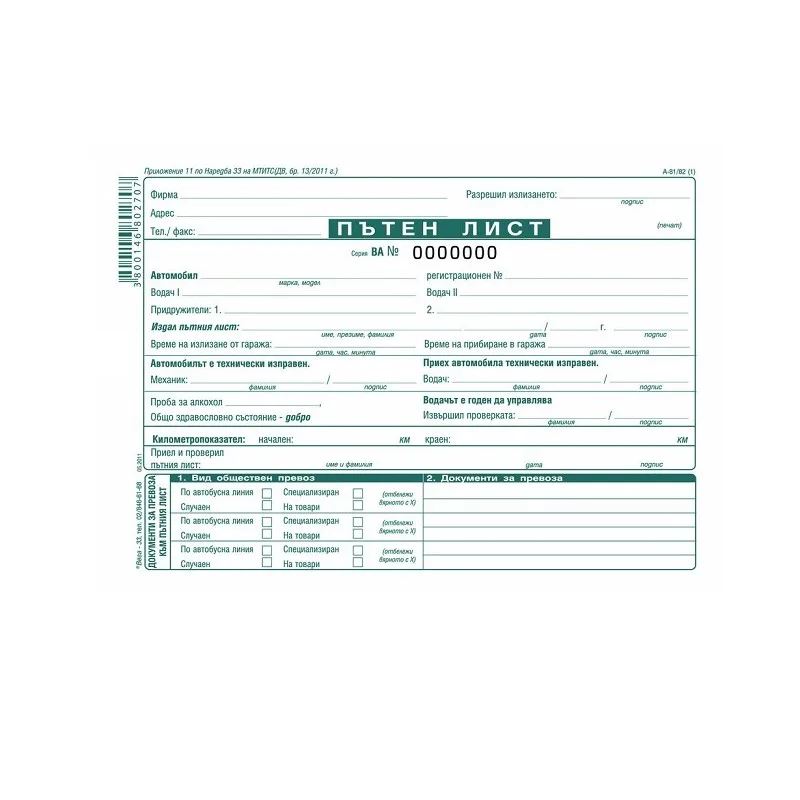
The journey log is a document that shows where, when and how many kilometres the vehicle travelled. It also records information about the driver, the type of fuel and its consumption rate set by the owner/manager of the company. The document is signed by the driver, who thereby confirms the information stated in the journey log.
At the beginning of the journey log you must record the vehicle’s initial mileage. As a rule, the value on the last date of the previous month is stated. For example, if on the last day of March 2025 the mileage was 130000 km, then this value is entered as the initial one on 01.04.2025.
If the owner also uses the car for personal purposes, these trips are not stated in the journey log – only the mileage related to the company’s activity. In this case the vehicle’s initial mileage in the journey log may differ from the one recorded on the last day of the previous month. For example, on 31.03.25 the mileage was 130000 km, and after that the owner used the car for 4 days not for work but for personal trips. On 05.04.25 the owner again uses the car for work and enters the mileage as of 04.04.25 – 131000 km – as the initial one. Fuel costs from 1 to 4 April are not counted as company expenses. Similarly, if personal trips were made in the middle of the month, once the car returns to work you must state new initial mileage values.
Journey logs can be printed out yourself after downloading them online, or bought already printed, for example in the form of a «пътна книжка».
Fuel consumption report
In addition to the journey log, a fuel consumption report must also be completed. These documents are not interchangeable; both must be drawn up. The information from the journey log is transferred into the report.
The upper left part of the report states the fuel consumption for the relevant vehicle in summer or in winter. The fuel consumption rate may be given for urban driving, for driving outside the city, or as a combined figure – at the owner’s choice.
The upper right part of the document states the following data:
the company name;
vehicle data – type, registration number, type of fuel;
the vehicle driver’s data;
initial mileage;
fuel present in the tank;
the cost of the fuel.
The data on the initial mileage, the fuel present and its cost are taken from the previous report (the information for the last day of the previous month).
The report states the receipt and the consumption of fuel.
The «Receipt» column records the data from the invoices issued by filling stations – invoice numbers and dates, seller, quantity of fuel. The cost of the fuel is stated as the total amount for companies not registered for VAT, and excluding VAT for companies registered for VAT.
The «Consumption» column records the dates on which the vehicle was used (taken from the journey log), the grounds (an explanation of what the car was used for), the initial mileage, the kilometres covered in the city and outside it, and the final mileage.
The last part of the report presents information on the total consumption, the mileage for the reporting period, as well as the quantity of fuel remaining and its cost.
Alongside preparing documents «the old-fashioned way» on paper, there are applications that allow document flow to be automated. They help generate journey logs and fuel expense reports simply by entering the required data. Let us remind you once again that drawing up such documents is mandatory – if they are missing, fuel costs are deemed unjustified.