
Annual reporting in Bulgaria from 2027: a single system
NSI, the National Revenue Agency (NAP) and the Registry Agency are introducing the "Single Entry Point" information system From 1 January 2027, a new procedure…
The Treaty of Berlin, adopted after (and instead of) the Treaty of San Stefano, severely limited Bulgaria's rights. The new Bulgaria did not include many lands historically inhabited by Bulgarians that had previously been part of the country.

This shaped state policy for the years to come: the national question was extremely pressing, and beyond the borders of the young principality Bulgarians continued to fight for independence.
In the meantime, Bulgaria was learning to live in a new way. With the help of Russian lawyers, a Constitution was drafted under which all citizens of the state became equal before the law. Sofia became the capital of the country because of its location in the centre of the Balkans and its proximity to Macedonia. And at the Grand National Assembly a Bulgarian prince was elected — the German prince Alexander von Battenberg. After five centuries of Ottoman rule Bulgaria had no aristocracy of its own, so the ruler was chosen at the suggestion of Russian diplomats — he was a lieutenant general of the Russian army and a nephew of the Russian tsaritsa, the wife of Alexander II.
Of course, there were certain difficulties: there was friction between the liberals and the conservatives; state policy changed; relations with foreign states became strained and then improved, including with
the Russian Empire.
In September 1885 Eastern Rumelia — the part of the country whose main city was Plovdiv — was annexed to Bulgaria. For Bulgaria this was a great achievement, but other countries did not approve of the annexation: it ran counter to the interests of Austria-Hungary and Russia. As a result, following a conspiracy, Alexander von Battenberg was deposed in 1886, and in 1887 Ferdinand I became prince of Bulgaria.
At the same time Bulgaria began to develop rapidly: railways and ports were built, new plants and factories appeared, and reforms were carried out in agriculture.
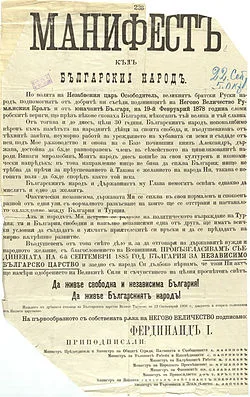
The country’s rapid development was hindered only by its status as a vassal of the Ottoman Empire and its dependence on it. The Bulgarian government assessed the situation in Europe and the fact that the Ottoman Empire no longer had the active support of other powers, and decided that the time had come to rid itself once and for all of the restrictions imposed by the Treaty of Berlin. And on 22 September 1908 Prince Ferdinand announced in Veliko Tarnovo that from then on Bulgaria was fully independent, after which he became tsar of the country. That day became a national holiday: every year on 22 September Bulgarians celebrate Independence Day together.

To the list of all articles
To the list of articles Useful articles
Did not find the answer here? Write to us — we will look at your case and tell you what comes next.
Mon–Fri 9:00–17:30 (EET)
Ask a question Useful information
NSI, the National Revenue Agency (NAP) and the Registry Agency are introducing the "Single Entry Point" information system From 1 January 2027, a new procedure…
 Useful information
New amendments to the Law on Foreigners (ZChRB) could change the rules on employment of foreigners and on keeping residence status in Bulgaria.
 Useful information
The subject of obtaining an EU Blue Card (Синя карта на ЕС) in Bulgaria remains one of the most discussed topics among foreign highly qualified specialists and employers.
This article describes the general procedure. Your situation almost always has specifics — tell us about it and we will point out the shortest route.
Book a consultation